


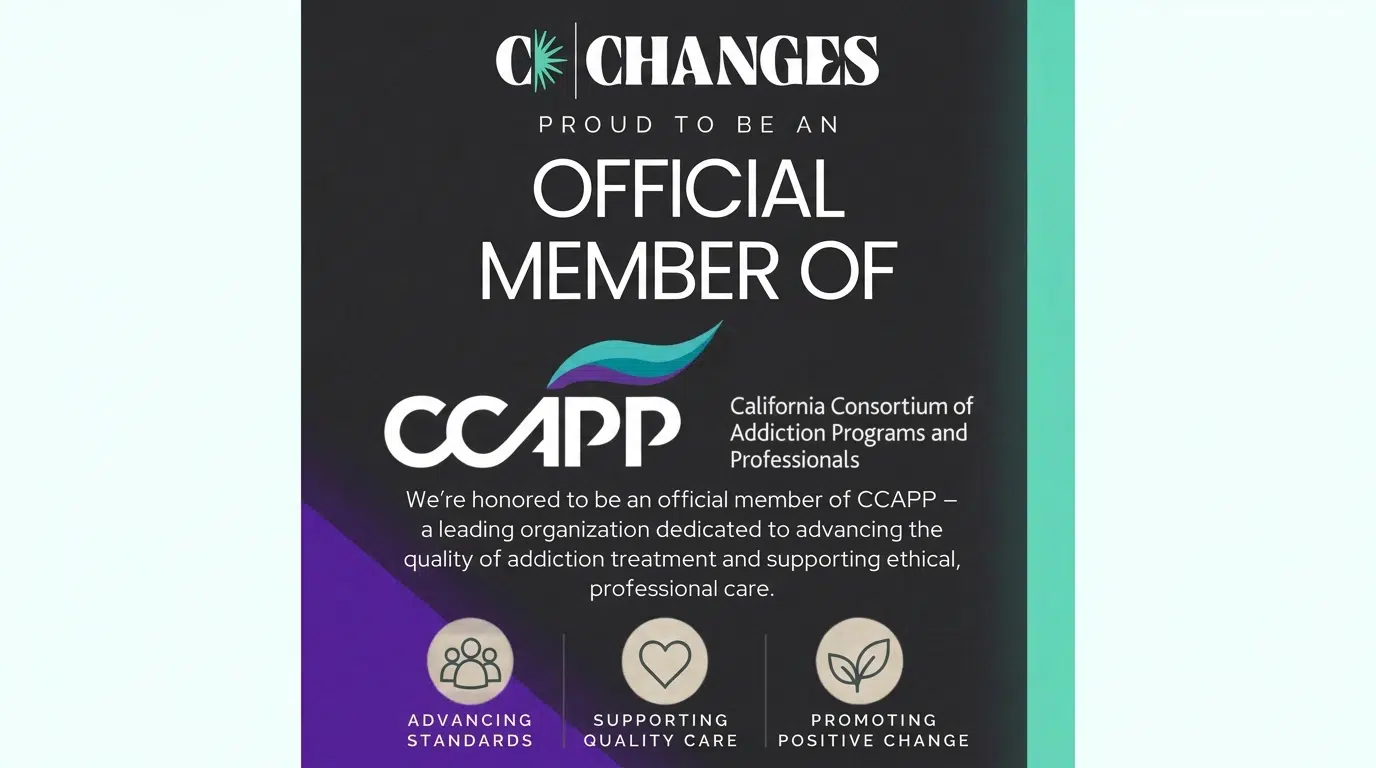

Changes Treatment Center is proud to announce that we are now an official Program Member of the California Consortium of Addiction Programs and Professionals (CCAPP) and have received its Program of Distinction recognition.
Becoming a CCAPP Program Member reflects our continued commitment to quality addiction treatment, ethical professional care, and meaningful involvement in the larger recovery community.
For clients and families, recognition like this matters because choosing a treatment provider can feel overwhelming. Professional memberships, accreditation, experienced clinical teams, and transparent treatment practices can all provide additional information when deciding where to seek care.
What Is CCAPP?
CCAPP stands for the California Consortium of Addiction Programs and Professionals.
Founded in 1972, CCAPP represents substance use disorder programs and professionals throughout California. The organization describes its mission as promoting excellence in services related to substance use through advocacy, professional competence, ethics, membership, and governance.
Its work connects treatment programs, counselors, behavioral health professionals, educators, and others working throughout the addiction treatment field.
CCAPP focuses on areas such as:
- Professional standards
- Ethics
- Workforce development
- Credentialing
- Education
- Advocacy
- Industry collaboration
- Supporting substance use treatment programs and professionals
For treatment organizations, membership provides an opportunity to stay connected with the broader addiction treatment community and participate in ongoing professional development.
What Does Being a CCAPP Program Member Mean?
A CCAPP Program Membership connects an addiction treatment organization with one of California’s established professional associations for substance use treatment programs and professionals.
CCAPP’s program membership includes professional resources, educational opportunities, industry involvement, and a recognition badge acknowledging membership as a program of distinction.
For Changes Treatment Center, membership represents another way to remain engaged with professionals and organizations working to advance addiction treatment throughout California.
It supports three areas highlighted in our announcement:
- Advancing standards
- Supporting quality care
- Promoting positive change
These ideas align closely with the work happening every day inside treatment.
What Is a CCAPP Program of Distinction?
The Program of Distinction recognition is associated with CCAPP Program Membership.
CCAPP states that program members may display a badge recognizing their membership with CCAPP as a program of distinction.
For Changes, that recognition reflects participation in a professional community focused on substance use treatment, professional development, ethical practice, and improving the field.
It is important to understand what this recognition does and does not mean.
CCAPP membership is not the same thing as state licensure or healthcare accreditation. Instead, it is a professional program membership and recognition within the addiction treatment field.
That distinction matters because clients deserve clear information about the qualifications and recognition a treatment center holds.
How Is CCAPP Membership Different From Accreditation?
Treatment centers may hold several different types of licenses, certifications, accreditations, memberships, and professional affiliations.
They are not interchangeable.
CCAPP Program Membership connects Changes with a professional organization serving addiction programs and professionals in California.
Changes Treatment Center also separately holds Joint Commission accreditation, which involves an independent review process focused on healthcare quality and safety standards. Changes lists Joint Commission certification number 300755AP, effective September 15, 2024 through September 30, 2028.
Together, these different forms of professional involvement help show a broader commitment to maintaining strong treatment practices and remaining connected with developments in behavioral healthcare.
Why Professional Standards Matter in Addiction Treatment

People entering addiction treatment are often doing so during one of the most difficult periods of their lives.
They may be dealing with:
- Substance dependence
- Mental health symptoms
- Family conflict
- Employment problems
- Financial instability
- Legal concerns
- Loss of confidence
- Fear about what recovery will look like
Treatment providers have a responsibility to approach those situations professionally and ethically.
Strong standards help create consistency around how programs operate, how professionals interact with clients, and how treatment organizations continue developing their services.
That includes maintaining appropriate boundaries, respecting client privacy, supporting evidence-based practices, investing in staff development, and remaining accountable to professional expectations.
Membership in organizations such as CCAPP helps treatment programs remain connected to conversations happening across the wider addiction treatment field.
Supporting Quality Care

Quality addiction treatment involves much more than helping someone temporarily stop using alcohol or drugs.
Recovery often requires addressing the patterns surrounding substance use.
That may include:
- Mental health symptoms
- Stress
- Trauma
- Relationships
- Daily routines
- Coping skills
- Physical health
- Employment
- Identity
- Community
- Long-term recovery planning
At Changes, treatment is designed around helping clients actively participate in recovery while building skills that can continue serving them after structured treatment ends.
Our current programs include different levels of outpatient care so support can be matched to individual needs.
Treatment Options at Changes
Changes Treatment Center provides several levels of behavioral health and addiction treatment in Costa Mesa.
Partial Hospitalization Program
Our Partial Hospitalization Program (PHP) provides a higher level of outpatient structure for clients who need significant therapeutic support while continuing to live outside a residential facility.
PHP can help provide stability while clients work on substance use, mental health symptoms, coping skills, and daily routines.
Intensive Outpatient Program
Our Intensive Outpatient Program (IOP) provides structured treatment several times per week while allowing clients greater flexibility around responsibilities outside treatment.
IOP can help clients continue developing recovery skills while gradually returning to more independent daily life.
Outpatient Treatment
Our Outpatient Program provides a lighter level of ongoing support for clients who have already established greater stability.
At Changes, outpatient care typically follows more intensive levels such as PHP or IOP and helps clients maintain progress as they return to increasingly independent routines.
Therapy and Psychiatric Support
Treatment can also include individual therapy, group therapy, psychiatric services, and other forms of clinical support based on each client’s needs.
These services can help address both substance use and mental health concerns that may affect long-term recovery.
Connection Is Part of Recovery

Professional standards matter, but treatment is still deeply human.
Recovery often becomes stronger when people feel connected to others who understand what they are going through.
Isolation can make addiction worse. Connection can create opportunities for accountability, encouragement, honest conversations, and shared experiences.
That is why community remains central to the Changes approach.
Our treatment environment encourages clients to:
- Build healthier relationships
- Participate actively in groups
- Learn from peers
- Ask for help
- Practice communication
- Develop accountability
- Reconnect with meaningful activities
- Create positive memories during recovery
The goal is not simply to complete treatment.
It is to build a foundation that can continue supporting life after treatment.
Continuing to Learn and Grow
Addiction treatment continues to evolve.
New research emerges. Clinical approaches improve. Professional expectations change. New challenges appear in communities.
Treatment programs should continue learning alongside those changes.
Participation in professional organizations can help treatment teams remain connected with broader discussions about addiction care, professional ethics, workforce development, and the future of behavioral health services.
For Changes, becoming a CCAPP Program Member is another part of that ongoing process.
Recognition is meaningful, but the work does not stop after receiving it.
The real value comes from continuing to improve how treatment is delivered and how clients and families are supported.
What This Means for Clients and Families
Clients should never choose a treatment center based on a single badge, membership, or credential.
Instead, consider the full picture.
When researching addiction treatment, ask about:
- Licensing
- Accreditation
- Clinical staff qualifications
- Available levels of care
- Treatment approaches
- Mental health services
- Individual and group therapy
- Psychiatric support
- Insurance and payment options
- Continuing care
- Family involvement
- Professional memberships
- How treatment plans are developed
Changes’ CCAPP Program Membership adds another professional affiliation to that larger picture.
Our commitment remains the same: provide structured care, meaningful connection, and support that helps people participate actively in their recovery.
Proud to Be Part of the CCAPP Community
We are proud to join CCAPP as a Program Member and receive Program of Distinction recognition.
The recognition represents more than another logo on a website.
It connects Changes with a statewide community of addiction professionals and programs working to strengthen the field, support ethical care, and improve how people affected by substance use receive help.
For us, that work continues every day through the clients, families, clinicians, and recovery community we serve.
Community. Recovery. Memories.
Start Your Recovery at Changes
If you or someone you love is struggling with substance use, professional support is available.
At Changes Treatment Center, we provide PHP, IOP, outpatient treatment, therapy, psychiatric support, and Beyond Therapy programming in Costa Mesa, California.
Call (949) 807-2008 for a confidential conversation about treatment options and the next step toward recovery.
Frequently Asked Questions
What Is CCAPP?
CCAPP is the California Consortium of Addiction Programs and Professionals, a professional organization representing substance use disorder programs and professionals throughout California. Its work focuses on areas including professional standards, ethics, education, advocacy, credentialing, and industry development.
Is Changes Treatment Center a CCAPP Member?
Yes. Changes Treatment Center has announced that it is now an official CCAPP Program Member and has received Program of Distinction recognition.
What Does CCAPP Program of Distinction Mean?
CCAPP offers its program members a recognition badge identifying their membership as a program of distinction. It represents participation in CCAPP’s professional program community and should not be confused with healthcare accreditation or state licensure.
Is CCAPP Membership the Same as Joint Commission Accreditation?
No. They are separate. CCAPP Program Membership is a professional membership and recognition, while Joint Commission accreditation involves an independent healthcare accreditation process. Changes Treatment Center separately holds Joint Commission accreditation.
What Treatment Programs Does Changes Offer?
Changes Treatment Center offers PHP, IOP, outpatient treatment, therapy, psychiatric support, case management, and Beyond Therapy programming. The appropriate level of care depends on each person’s clinical needs and recovery situation.