






Recovery doesn’t always mean leaving your life behind. For a lot of people, healing has to happen inside the same world they live in. The job, the kids, the house, the bills, the relationships that need rebuilding. Outpatient treatment was built for that reality. It’s a structured level of care that gives you real therapy, real support, and real accountability while you sleep in your own bed at night and keep showing up for the people who count on you. Understanding outpatient treatment in practice can help you figure out if it’s the right level of care for you or someone you love.
What Outpatient Treatment Actually Means
Outpatient treatment is a level of care that supports people dealing with substance use, mental health struggles, or both, without requiring them to live inside a treatment facility. You attend sessions during the day or evening and go home afterward.
That single difference changes everything. You’re not stepping out of your life to get better. You’re learning how to be well inside the life you already have. The skills you learn in therapy get tested the same day, in real situations, with the same people and triggers that shaped how you got here.
For some people, this is exactly the right starting point. For others, it’s the next step after a residential or detox stay. Either way, outpatient care meets you where you are instead of asking you to disappear from your own life to heal. At Changes, that’s exactly how our programs are built. Real clinical support, scheduled around the life you’re already living.
The Three Levels of Outpatient Care
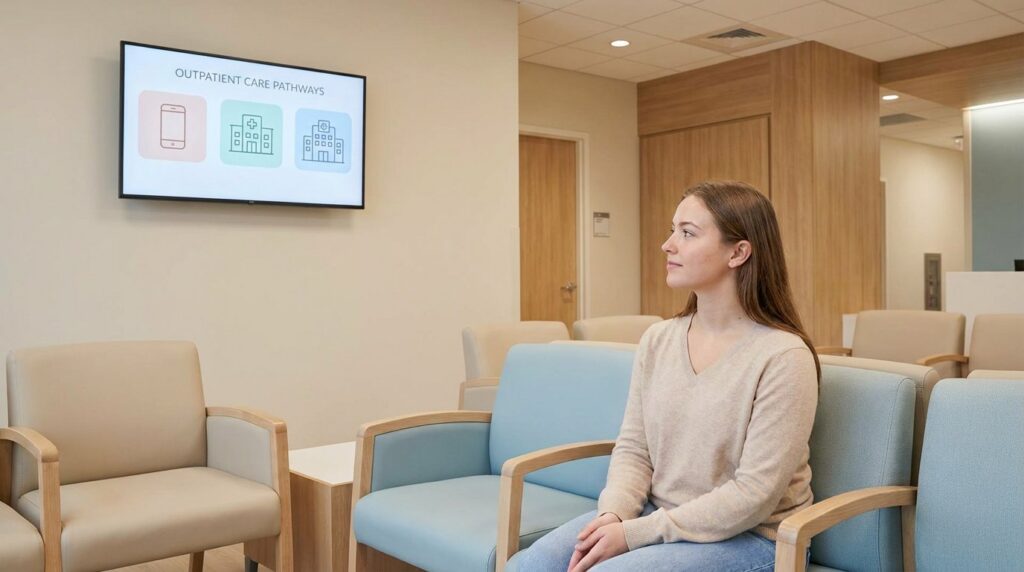
People often think of outpatient as one thing, but it’s actually a spectrum. The level of care you need depends on how much structure your recovery needs right now. At Changes Treatment Center, we offer three main tiers.
Partial Hospitalization Program (PHP)
PHP is the most structured form of outpatient care. You spend most of the day in treatment, usually five to six hours a day, five days a week. It’s a strong fit for people who need close clinical support but don’t need overnight supervision. Think of it as the bridge between residential care and a less intensive schedule.
Intensive Outpatient Program (IOP)
IOP scales back the hours while keeping the depth of the work. You attend treatment several days a week, often for three hours at a time, with sessions scheduled around work or school. It’s built for people who are stable enough to handle daily life but still need consistent therapy, group work, and accountability.
Outpatient Treatment (OP)
Standard outpatient is the lightest level of care, designed for people who have built a strong base and want continued support as they keep moving forward. Fewer hours, same quality of clinical work, more independence.
What Happens Inside Outpatient Treatment
Outpatient care isn’t one type of session repeated over and over. It’s a layered approach where each piece does something different. Here’s what the work actually looks like at Changes.
- Individual therapy. One-on-one sessions where you do the deeper work. The patterns, the history, the things you don’t say out loud anywhere else.
- Group therapy. Sitting in a room with people who get it. Group is where shame loses its grip, because you stop being the only one carrying what you’re carrying.
- Case management. Help with the practical side. Housing, employment, court obligations, insurance, family logistics. The stuff that gets in the way of recovery when no one is helping you sort it.
- Psychiatric evaluations. Our Psychiatric Mental Health Nurse Practitioner (PMHNP) handles medication assessments and management when that piece is part of your care. Mental health and substance use often show up together, and treating one without the other rarely works.
- Beyond Therapy activities. Cooking, fitness, creative work, time outdoors, and community-building experiences. Recovery isn’t only what happens in a therapy chair. Some of the most important shifts happen when you’re moving, making something, or laughing in a group of people who actually see you.
Who Outpatient Treatment Is For
Outpatient is a strong fit for a lot of different people, and not always who you’d expect. You don’t have to hit a specific kind of bottom to qualify for help. You don’t have to be in crisis. You just have to be ready to do the work.
It tends to be the right level of care for people who:
- Have completed detox or residential treatment and need a structured next step
- Have a substance use issue that hasn’t yet required a higher level of care
- Are you managing a mental health condition alongside substance use
- Need clinical support, but also need to keep working, parenting, or studying
- Have a safe and stable place to live during treatment
- Want long-term recovery, not a quick fix
If you’re not sure which level of care fits your situation, that’s not something you have to figure out alone. A clinical assessment makes the picture clearer in about an hour.
Why Outpatient Works: Structure Plus Real Life
The thing that makes outpatient effective is also the thing that scares people about it. You go home every night. You face the same people, the same kitchen, the same neighborhood, the same phone full of contacts you’re trying to put down. That’s the gift and the test at the same time.
Recovery that only works inside the walls of a treatment center doesn’t prepare you for the world. Outpatient care builds your recovery in the world, with the support you need to keep showing up. That’s the way we approach it at Changes. Clinical depth during sessions, real-life practice between them, and a community that holds the line with you.
You don’t have to leave your life to heal. You have to learn how to live it differently.
Inpatient vs. Outpatient: How They Compare
If you’re trying to figure out where outpatient fits in the bigger picture of treatment, this side-by-side might help.
| Inpatient / Residential | Outpatient Treatment |
|---|---|
| You live at the facility | You live at home or in supportive housing |
| 24-hour clinical supervision | Scheduled sessions during the day or evening |
| Removes you from daily life | Builds recovery inside your daily life |
| Best for acute or unstable situations | Best for stable situations needing structure and support |
| Higher cost and longer time commitment per day | More flexible, often more affordable |
Recovery Isn’t One-Size-Fits-All
The biggest mistake in early treatment conversations is treating recovery like a single product on a shelf. It isn’t. The way one person heals is rarely the way the next person heals. Some people need months of residential care first. Some thrive in IOP from day one. Some need to layer outpatient support on top of long-term aftercare for years.
Healing happens through support, structure, community, and learning how to reconnect with yourself again. Those four pieces show up in every level of care, just in different proportions.
Our goal at Changes is to create a space where people feel safe, seen, supported, and empowered to build a life they’re proud of. The level of care is a tool. The real work is the person sitting in the chair.
What to Expect in Your First Few Weeks
The first couple of weeks of outpatient treatment can feel intense, and that’s normal. You’re showing up consistently to do work most people spend a lifetime avoiding. A few things tend to happen early on:
- Your nervous system starts to settle. Without the substance running the show, your body needs time to find a new baseline. Sleep, appetite, and energy can swing for a while.
- Emotions come back online. Feelings that were numbed for years start showing up at full volume. That’s uncomfortable, and it’s also a sign that something is working.
- Patterns become visible. Things you didn’t notice about how you cope, who you reach for, what you avoid. Therapy and group help you see the shape of those patterns clearly.
- You start to trust the process. Not because someone tells you to, but because you notice yourself sleeping better, thinking clearer, and handling moments you used to run from.
Call Today and Step Into a Program Built Around Your Life
Recovery doesn’t have to mean walking away from everything you’ve worked for. At Changes Treatment Center, we offer PHP, IOP, and standard outpatient treatment, along with therapy, psychiatric care, case management, and our Beyond Therapy programming. Located in Costa Mesa, California, we’re here when you’re ready to take the next step. Call (949) 807-2008 today to talk through what level of care might be right for you.
Frequently Asked Questions
How is outpatient treatment different from inpatient treatment?
Inpatient treatment requires you to live at the facility while you receive care. Outpatient treatment lets you live at home or in supportive housing while attending structured therapy sessions during the day or evening. Outpatient is often the right next step after inpatient, or a strong starting point for people whose situations are stable enough not to need 24-hour supervision.
How long does outpatient treatment usually last?
It depends on the level of care and your individual needs. PHP often runs four to six weeks. IOP can last eight to twelve weeks or longer. Standard outpatient can continue for months as part of long-term support. Your clinical team works with you to adjust the timeline based on how you’re progressing, not a fixed calendar.
Can I keep working or going to school during outpatient treatment?
Yes, especially in IOP and standard outpatient. Sessions are scheduled in blocks that leave time for work or classes, and case management helps you sort the practical pieces so treatment fits into your real life. PHP is more time-intensive, so people in that level of care often take time off work during that phase.
Is outpatient treatment covered by insurance?
Most major insurance plans cover some level of outpatient care, though the specifics vary. The fastest way to know what your plan covers is a quick verification call. Our admissions team handles that for you, usually within a few hours, so you’re not stuck guessing at coverage.
How do I know which level of outpatient care is right for me?
A clinical assessment is the most honest answer to that question. Self-diagnosing the level of care you need is hard, and most people either overestimate or underestimate what they’re dealing with. A short conversation with our clinical team gives you a clear, personalized recommendation based on what’s actually going on for you right now.